In 2006, three entrepreneurs — Jay Coen Gilbert, Bart Houlahan, and Andrew Kassoy — built and sold AND1, a basketball streetwear company.
After the sale, they reflected on the experience and felt something was missing. There was no built-in way to legally or structurally prioritize workers, the environment, or community alongside profit. It was profit maximization over everything, with the rest left to the "invisible hand." For 250 years, most people had accepted Adam Smith's thesis — that self-interest, competition, and falling prices add up to a public good — without considering the fact that Smith himself, an 18th-century moral philosopher, had never actually run a company.
The founders disagreed with that thesis, at least with how absolute it had become. So in 2006 they started the non-profit B Lab. B Lab was responsible for two major innovations:
- B Corp certification → like a "Fair Trade" label, but for entire companies
- Benefit corporation (legal structure) → a legal form (passed later, starting ~2010 in states) that lets companies officially balance profit + purpose
2006 marked the beginning of certified B Corps globally. Twenty years later, there are over 10,500 B Corps worldwide employing more than a million people (this figure includes Certified B Corps, Benefit Corporations, and PBCs). Going from a handful in 2007 to 10,500 today works out to roughly 30% annual growth. That kind of growth makes you think maybe there's something to these B Corps.
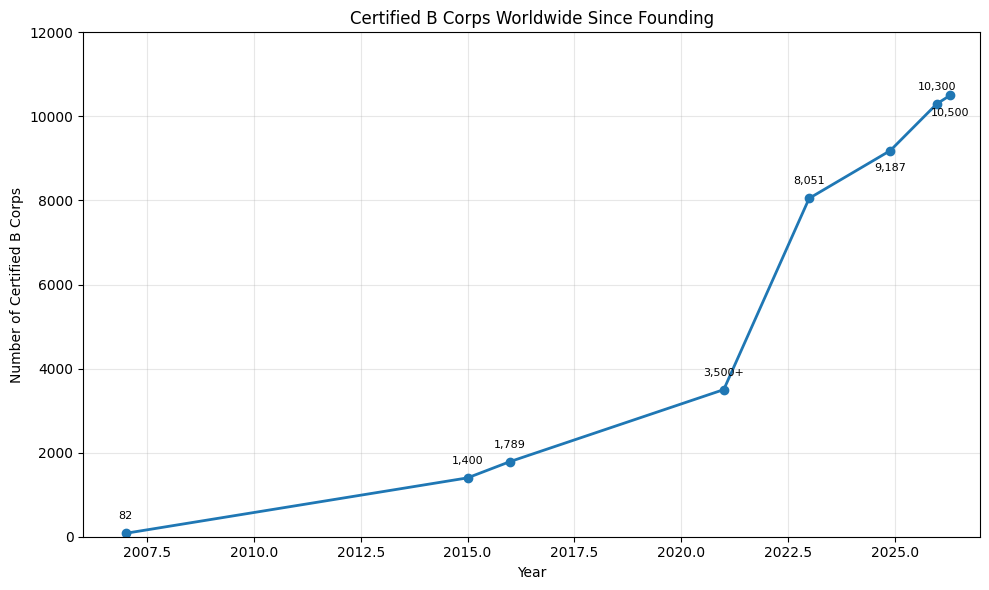
Three terms, often confused
Before we start discussing B Corps at large, let's distinguish three labels that get used interchangeably, but shouldn't be:
- Certified B Corp — a voluntary certification from the non-profit B Lab. Like a Fair Trade label, but for the whole company.
- Benefit Corporation — a legal entity type recognized by state law (alongside LLCs and Inc.s), starting around 2010, requiring directors to weigh stakeholders beyond shareholders.
- Public Benefit Corporation (PBC) — Delaware's investor-friendlier flavor of the Benefit Corporation, enacted in 2013, and the version most VC-backed startups adopt.
A company can be one, two, or all three. The certification (B Corp) is voluntary; the legal forms (Benefit Corp, PBC) live in state corporate codes.
Why Many AI Labs are PBCs
Now that we have the vocabulary, how are these companies actually performing 16–20 years in?
Pretty good, it turns out.
OpenAI, Anthropic, Inflection AI, and many other frontier AI companies are or were structured as PBCs (each took a slightly different route: Anthropic is a Delaware PBC from day one, OpenAI's for-profit arm restructured to a PBC, Inflection was a PBC before much of it was absorbed by Microsoft). Anthropic and OpenAI are both closing in on the $1T valuation mark.
Of course, only pointing to PBCs pursuing AGI would be a faux pas, but it does underscore an important point: when the stakes are civilizational, founders and investors are ready to use structures that encode responsibilities beyond maximizing shareholder return. That raises a broader question: should other mission-critical industries, like biotech, defense, climate infrastructure, education, and financial systems, also include more PBCs so alignment, trust, and long-term accountability are designed into the company itself rather than bolted on later?
(As an aside, it's also a fun thought experiment to imagine how the previous waves of tech (PC, mobile, cloud) might have been different if they'd been pioneered under this structure.)
Beyond the AI lab PBCs, here is a list of the 19 publicly traded Benefit Corporations.
The publicly traded Benefit Corps
| Company | Ticker | Notes |
|---|---|---|
| Laureate Education | LAUR | |
| Lemonade | LMND | |
| Vital Farms | VITL | |
| Coursera | COUR | |
| Veeva Systems | VEEV | |
| United Therapeutics | UTHR | |
| Amalgamated Financial | AMAL | |
| Broadway Financial Corp. | BYFC | |
| Warby Parker | WRBY | |
| Allbirds | BIRD | |
| Zevia PBC | ZVIA | |
| Planet Labs PBC | PL | |
| The Vita Coco Company | COCO | |
| Grove Collaborative | GROV | |
| BRC Inc. / Black Rifle Coffee | BRCC | |
| The Oncology Institute | TOI | PBC status less cleanly surfaced in SEC filings |
| Aptera Motors | SEV | Nasdaq listing in 2025/2026 filings |
| AppHarvest | APPH | Former public PBC; bankrupt/delisted |
| Zymergen | ZY | Former public PBC; acquired by Ginkgo |
Honestly, looking at how this group has performed, I cannot make the argument that Benefit Corps as a category is beating the S&P. It isn't — at least not for the publicly traded ones above.
But here's a different claim I'll defend: when a strongly mission-driven organization is paired with a corporate structure that holds it accountable to something beyond profit, and the team executes well, the upside is unusually high — higher than equivalent C-Corp competitors.
PBCs are one expression of that, but they're not the only one. Once you broaden the lens to alternative structures generally — co-ops, foundation ownership, non-profit parents, perpetual purpose trusts, mission locks — the pattern gets more striking:
- Coursera, United Therapeutics, Planet Labs, Vita Coco, Lemonade, Amalgamated Financial, Broadway Financial — all standout Public Benefit Corporations from the list above.
- Patagonia — owned by the Holdfast Collective trust as of 2022; profits go to climate work.
- Novo Nordisk — controlled by the Novo Nordisk Foundation, which owns the majority voting stake.
- Tony's Chocolonely — Dutch BV with a "mission lock" structure preventing mission drift.
- Tillamook — a farmer-owned cooperative.
- Ben & Jerry's — a Certified B Corp operating as a wholly-owned subsidiary of Unilever, with an independent board mandated to defend the social mission.
The shape of the structure varies. The success of these companies doesn't.
Let's pick one of the companies from the above list: Coursera vs. the rest of the edTech field
If you want a roughly apples-to-apples test, online edTech is a good one. The market didn't exist before the internet took off, most of the major players were founded within a few years of each other, and Coursera is the lone PBC in the bunch.
| Company | Corporation type | Status | Market cap / estimated value | Year launched |
|---|---|---|---|---|
| MasterClass | C-Corp | Private | $2.75B (last round) | 2015 |
| Domestika | C-Corp | Private | ~$1.3B (last known) | 2002 |
| Coursera | Public Benefit Corporation (PBC) | Public | $869M | 2012 |
| Udemy | C-Corp | Public | $646M | 2010 |
| Codecademy | C-Corp (subsidiary) | Owned by Skillsoft | Acquired for $525M | 2011 |
| Docebo | C-Corp | Public | ~$463M | 2005 |
| DataCamp | C-Corp | Private | ~$300M–$800M (est.) | 2013 |
| Khan Academy | Nonprofit (501c3) | Nonprofit | No market cap (~$136M assets) | 2008 |
| Skillshare | C-Corp | Private | ~$106M (est.) | 2010 |
| Udacity | C-Corp | Owned (Accenture) | ~$80M–$100M (sale) | 2011 |
| Thinkific | C-Corp | Public | ~$74M USD / CAD $104M | 2012 |
| Skillsoft | C-Corp | Public | $56M | 1998 |
| edX / 2U | C-Corp (2U) | Private (post-bankruptcy) | ~$11.5M (post-restructuring) | edX 2012 |
Coursera is one of the youngest companies on the list and has the highest market cap among its public competitors. Even when compared with valuations for private companies, it still sits in the top 3. It obviously doesn't prove the structure is the cause — sample of one — but the same pattern can be replicated across other verticals -- banks, drinks, biotech, and more.
The next 100 years
C-Corps have been around for two centuries. PBCs and adjacent structures have only really taken root in the last couple decades. My guess is that over the next hundred, Benefit Corps and other alternatives will become the default rather than the curiosity.
Here's why I think that. The ability for a business to actually back its stated values — to put the money where the mouth is — turns out to be a real advantage in building consumer brands. Customers respect products and services that are genuinely held to a mission and a code. A few companies (Costco) maintain that discipline without any legal scaffolding, but most eventually succumb to the force of financial gravity. PBCs and their cousins simply have other and different forces at play: their charters point them at something other than next quarter's earnings, so they don't get pulled toward the same equilibrium their C-Corp competitors do.
I like to apply the analogy of different internal and external forces at play in a company. It makes businesses feel more like physical systems. If you know all the forces at play in a system, you can predict the equilibrium points, the trajectory, and much more about the system. Historically, we've mostly operated with a two-force model: financial gravity on one side and mission pull on the other — reflected in C-Corps versus nonprofits.
I've always thought there needed to be a hybrid between non-profits, where money is the means to the mission, and C-Corps, where the mission is to make money. Benefit Corps and other alternative corporate structures fill that gap. Their growing adoption suggests this isn't just my view — entrepreneurs, and increasingly the market, seem to agree.
For 250 years we ran the experiment of profit-maximization-as-default. It was a good experiment with incredible successes and generational companies. The B Corp generation isn't an outright rejection of that era — it's the next iteration. The new experiment is just beginning, and I think it has even more potential than the C-Corps that came before it.
Credit and shoutout to Eric Reyes for his talk inspiring this post and my fanboying over B Corps.